
For people holding ETH, the long-term concern is whether account security can adapt if quantum computers eventually break the elliptic-curve cryptography used today. As reported on November 16, 2026, Ethereum co-founder Vitalik Buterin argued that leanPCS could help Ethereum adopt quantum-resistant signatures without storing their full, much larger proofs and signatures onchain. It remains a proposal, not an enacted protocol change.
Buterin said a signature could grow from 65 bytes to between 1 and 6 kilobytes, while a zero-knowledge proof could grow from a few hundred bytes to about 128 kilobytes. EIP-8288, a draft he co-authored with developer Thomas Coratger in June, proposes aggregating published signatures and proofs into STARK proofs. Under the design, those proofs would be combined until one proof verifies the data for a block, leaving only short claims onchain.
Buterin described three possible approaches:
- leanSPHINCS would support one type of quantum-safe, hash-based signature, but not other uses.
- leanSTARK would support broader uses, including different signature schemes and privacy protocols, but would first require agreement on a language for users’ programs.
- leanPCS, his preferred route, aims for that broader flexibility with fewer initial design choices. Buterin said it could potentially be implemented quickly, with leanSTARK added later.
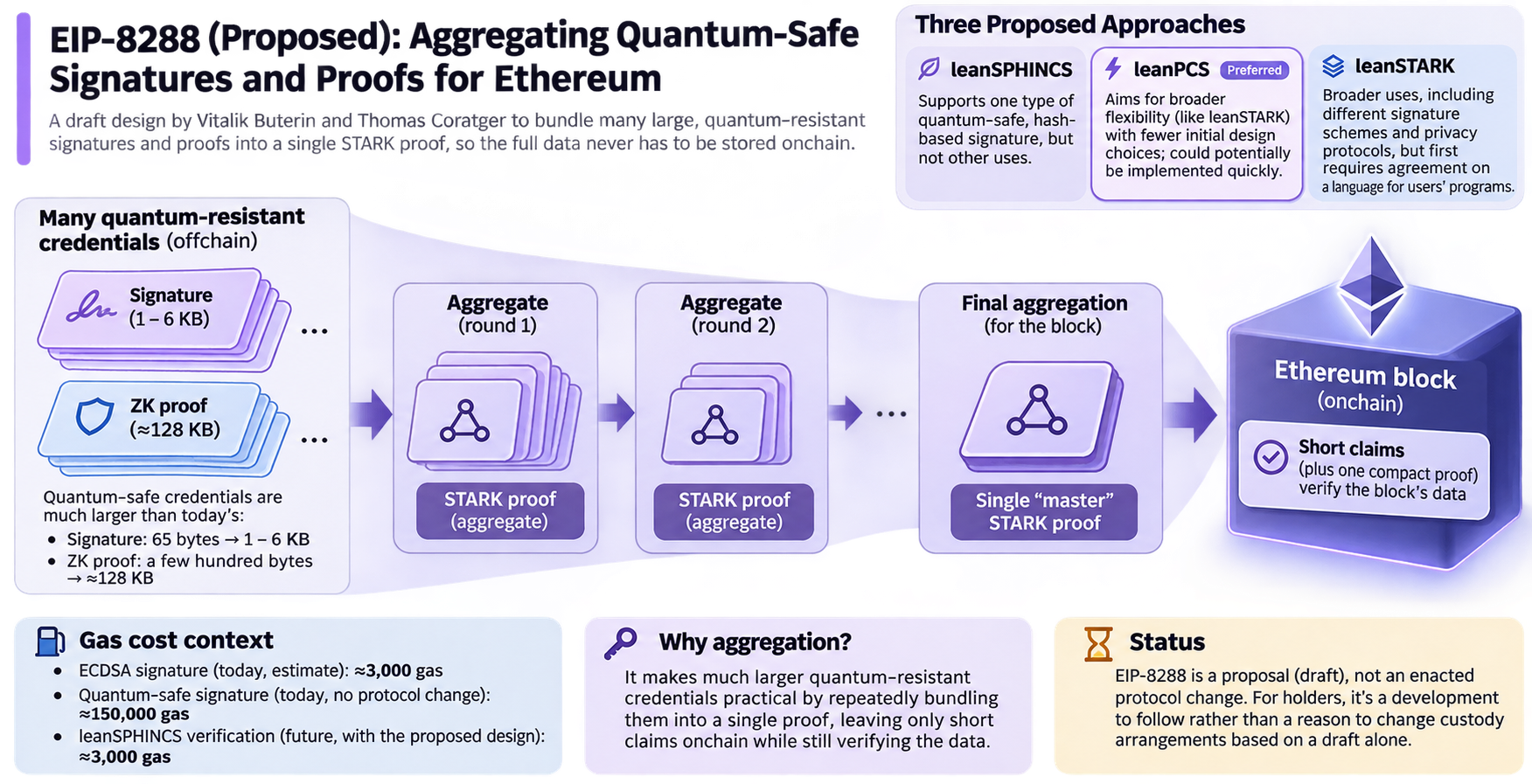
The cost difference helps explain the interest in aggregation. A June Ethereum Research post linked by Buterin said a standards-aligned quantum-safe signature could already be verified on Ethereum for about 150,000 gas without a protocol change. An earlier estimate from Buterin put an ECDSA signature at about 3,000 gas; the research post projected about 3,000 gas for a future protocol-level leanSPHINCS verification. Those future costs depend on the proposed design being implemented.
For holders, this is a development to follow rather than a reason to change custody arrangements based on a draft alone. The open question is how Ethereum would make larger quantum-resistant credentials practical while preserving the ability to verify them.
Source: decrypt.co (originally published 2026-11-16 17:54 UTC+8)