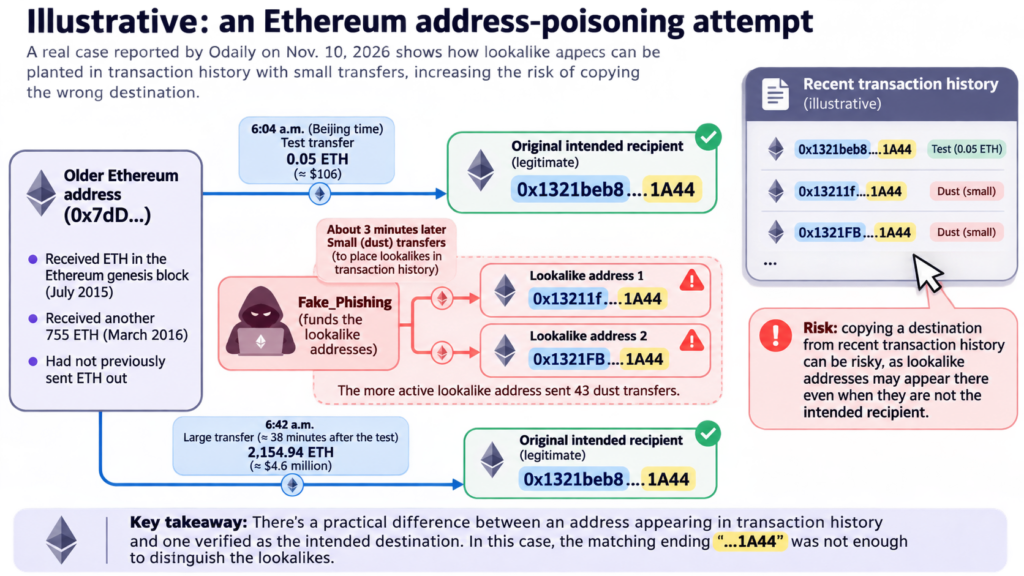
Copying a destination from recent transaction history can be risky: a lookalike address may appear there even when it is not the intended recipient. Odaily reported on November 10, 2026, that this address-poisoning tactic targeted an Ethereum address shortly before it moved 2,154.94 ETH. The report did not identify a loss from the attempt.
According to Whale Alert data cited by Odaily, the address, beginning 0x7dD, received ETH in Ethereum’s July 2015 genesis block and another 755 ETH in March 2016. It had not previously sent ETH out. At 6:04 a.m. Beijing time on November 10, it sent a first test transfer of 0.05 ETH, worth about $106, to an address beginning 0x1321beb8 and ending 1A44.
About three minutes later, the address began receiving small ETH transfers from two lookalike addresses. They began 0x13211f and 0x1321FB, and both ended 1A44. The account funding them was labeled “Fake_Phishing”; the more active lookalike address sent 43 dust transfers. Such transfers can place misleading addresses in a holder’s transaction history.
At 6:20 a.m., the new recipient address sent out 0.01 ETH, nearly all of which returned about three minutes later. At 6:42 a.m.—roughly 38 minutes after the first test—the older address sent 2,154.94 ETH, worth about $4.6 million, to the original intended address, beginning 0x1321beb8 and ending 1A44. Odaily reported that the recipient then held about 2,155 ETH.
The practical distinction is between an address appearing in transaction history and one verified as the intended destination. The matching endings in this case were not enough to distinguish the lookalikes.
Source: odaily.news (originally published 2026-11-10 15:13 UTC+8)