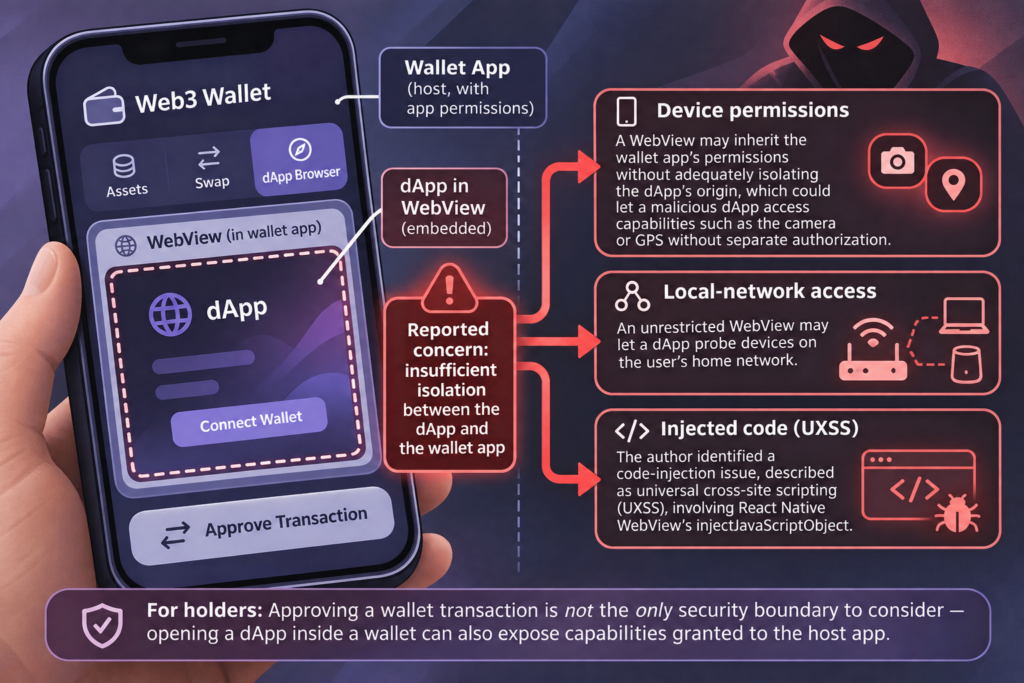
A wallet’s built-in dApp browser can create a security concern beyond the assets it displays. In an article published on June 19, 2026, the author reported finding insecure WebView integrations in more than 20 major mobile Web3 wallets. The supplied account does not name the wallets or establish that users suffered losses.
The reported issues involve three trust boundaries:
- Device permissions: A WebView may inherit the wallet app’s permissions without adequately isolating the dApp’s origin. According to the author, a malicious dApp could then access capabilities such as the camera or GPS without separate authorization.
- Local-network access: An unrestricted WebView may let a dApp probe devices on the user’s home network.
- Injected code: The author identified a code-injection issue, described as universal cross-site scripting (UXSS), involving React Native WebView’s
injectJavaScriptObject.
The author says the article includes exploitation examples and suggested fixes, but those details are not present in the supplied account. For holders, the practical distinction is that approving a wallet transaction is not the only security boundary to consider: opening a dApp inside a wallet can also expose capabilities granted to the host app.