
A confirmed transaction does not always mean every intended payment went through. In testing reported on November 17, 2026, Juicebox developers found that, under proposed Ethereum upgrade rules on the Sepolia testnet, an outer transaction could succeed even when an internal payment failed. The report describes a testnet compatibility risk, not a confirmed loss of funds on mainnet.
What the Juicebox tests showed
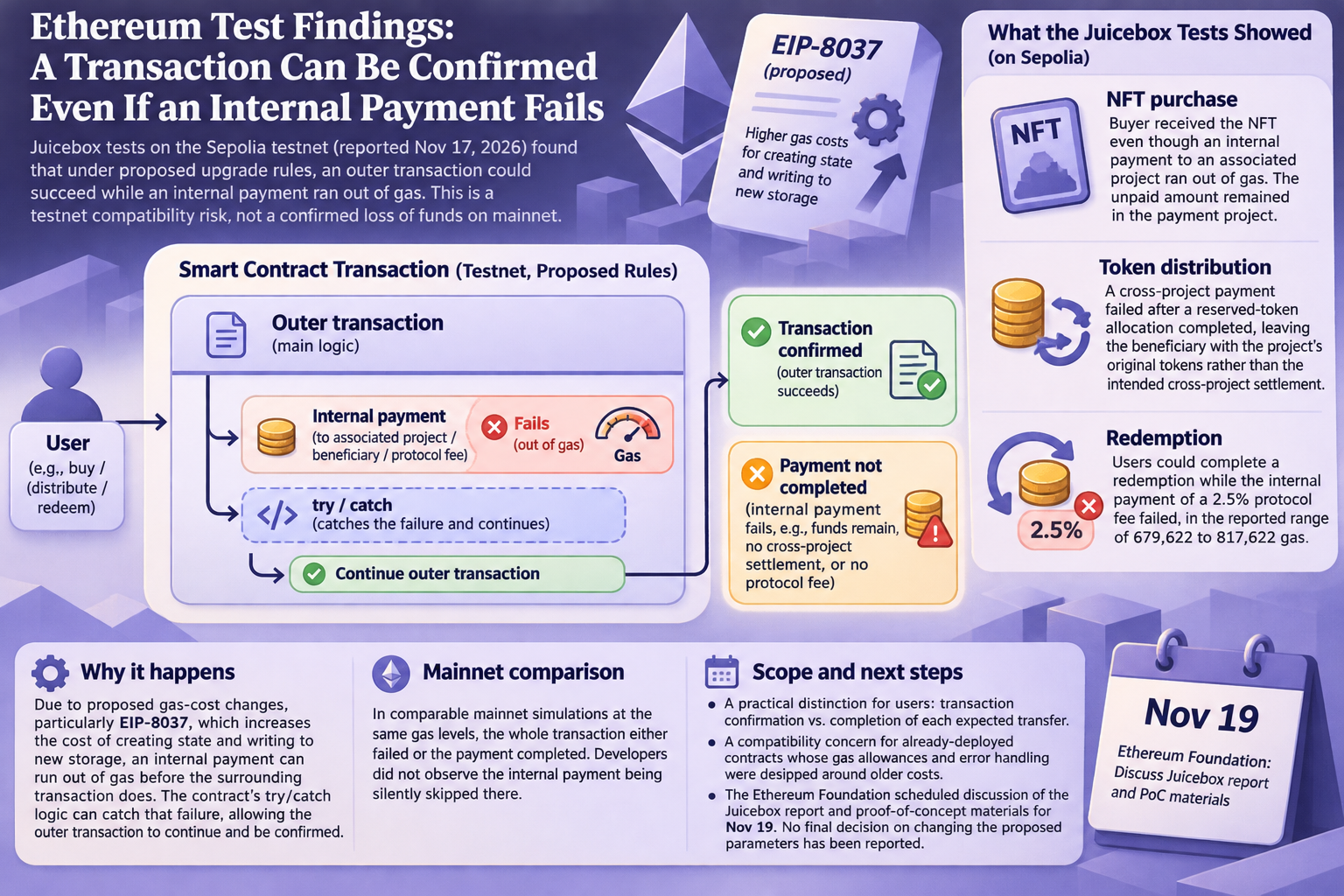
According to Juicebox’s technical documentation, an NFT purchase test gave the buyer the NFT even though an internal payment to an associated project ran out of gas. The unpaid amount remained in the payment project. In a separate token-distribution test, a cross-project payment failed after a reserved-token allocation completed, leaving the beneficiary with the project’s original tokens rather than the intended cross-project settlement.
A redemption test found another consequence: within the reported range of 679,622 to 817,622 gas, users could complete a redemption while the internal payment of a 2.5% protocol fee failed. These are reported simulation results, not evidence that users have avoided fees on mainnet.
Why the outer transaction could still succeed
Juicebox developer mejango linked the behavior to proposed changes in gas costs, particularly EIP-8037’s increase to the cost of creating state and writing to new storage. An internal payment could run out of gas before the surrounding transaction did. If the contract’s try/catch logic caught that failure, the outer transaction could continue and be confirmed without the payment.
The developers reported a different result in comparable mainnet simulations at the same gas levels: the whole transaction either failed or the payment completed. They did not observe the internal payment being silently skipped there.
For holders and protocol users, the practical distinction is between transaction confirmation and completion of each expected transfer. The tests also raise a compatibility concern for already-deployed contracts whose gas allowances and error handling were designed around older costs.
As of the November 17 report, the Ethereum Foundation had scheduled discussion of the Juicebox report and proof-of-concept materials for November 19. No final decision on changing the proposed parameters had been reported.