A wallet backup cannot protect funds if the seed was predictable when the account was created. In an analysis published on October 20, 2026, at 11:30 a.m. UTC+8, SlowMist described a Qubic Wallet flaw in which account seeds and a network packet-header field drew from the same non-cryptographic random stream.
SlowMist reported that a Qubic announcement on October 18 said an attacker had accessed 1,404 Qubic wallets and transferred approximately 2.94 trillion QU, exploiting insufficient randomness in some wallet seeds. SlowMist’s analysis explains a possible technical route; its local proof of concept does not, by itself, establish that this was the method used in those transfers.
Where the trust boundary failed
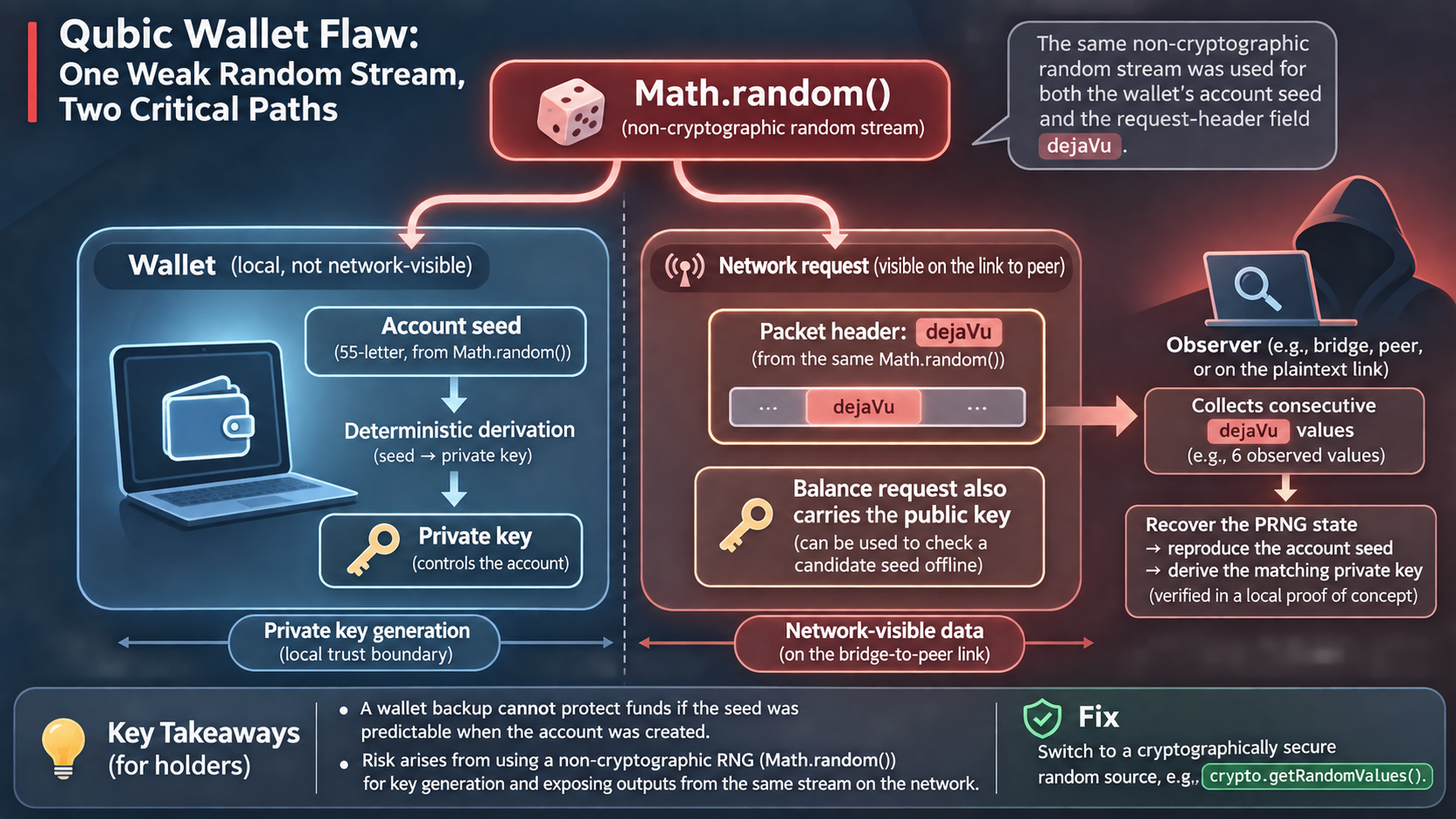
According to SlowMist, Qubic Wallet’s built-in generator used Math.random() to produce a 55-letter account seed when creating a vault or adding an account. That seed deterministically produced the private key, without a second random source in the derivation path described by the researchers.
The wallet’s @qubic-lib/qubic-ts-library dependency also used Math.random() to set the dejaVu field in Qubic request headers. SlowMist said a bridge, peer, or observer on the bridge-to-peer plaintext link could see those truncated random values. Balance requests also exposed the account’s public key, allowing a candidate seed to be checked offline.
In SlowMist’s local proof of concept, six consecutive dejaVu values were enough to recover the modeled random-generator state and reproduce a matching private key. That is six observed values, not six wallet connections. The researchers cautioned that real-world success depends on the observer’s position, the continuity and alignment of the values, and whether other calls consumed randomness between them.
SlowMist listed the flaw as fixed by switching to crypto.getRandomValues(). The practical distinction for holders is between protecting an existing backup and trusting how its seed was originally made: securing a backup cannot add randomness to a seed after its creation. The source does not establish which individual accounts were affected or provide an account-by-account test.
Source: mp.weixin.qq.com (originally published 2026-10-20 11:30 UTC+8)