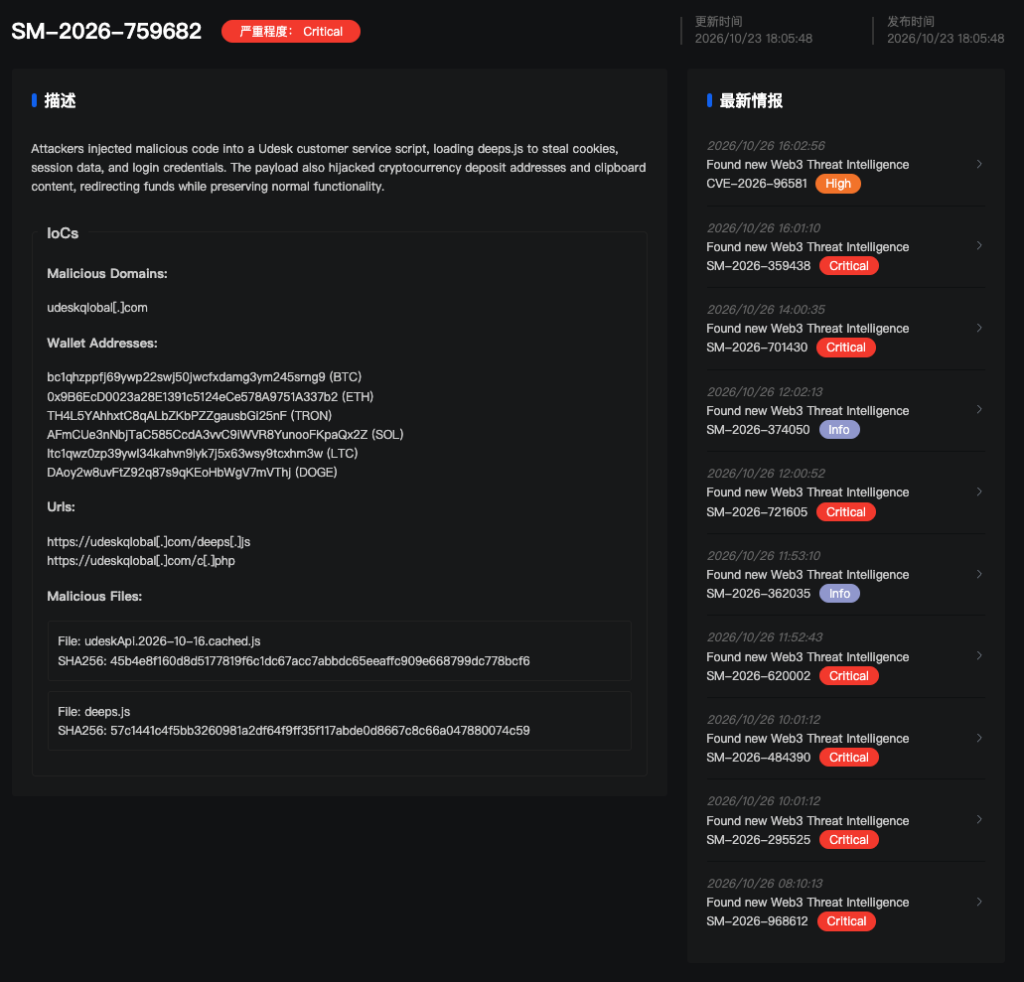
A deposit address displayed on a website is only as trustworthy as the scripts running on that page. In an analysis published on October 27, 2026, at 17:51 (UTC+8), SlowMist reported finding malicious code associated with a Udesk customer-service script. Its analysis identified two risks: collection of data accessible to the page and replacement of deposit addresses on certain sites. The report did not establish that funds were lost.
How the code entered pages
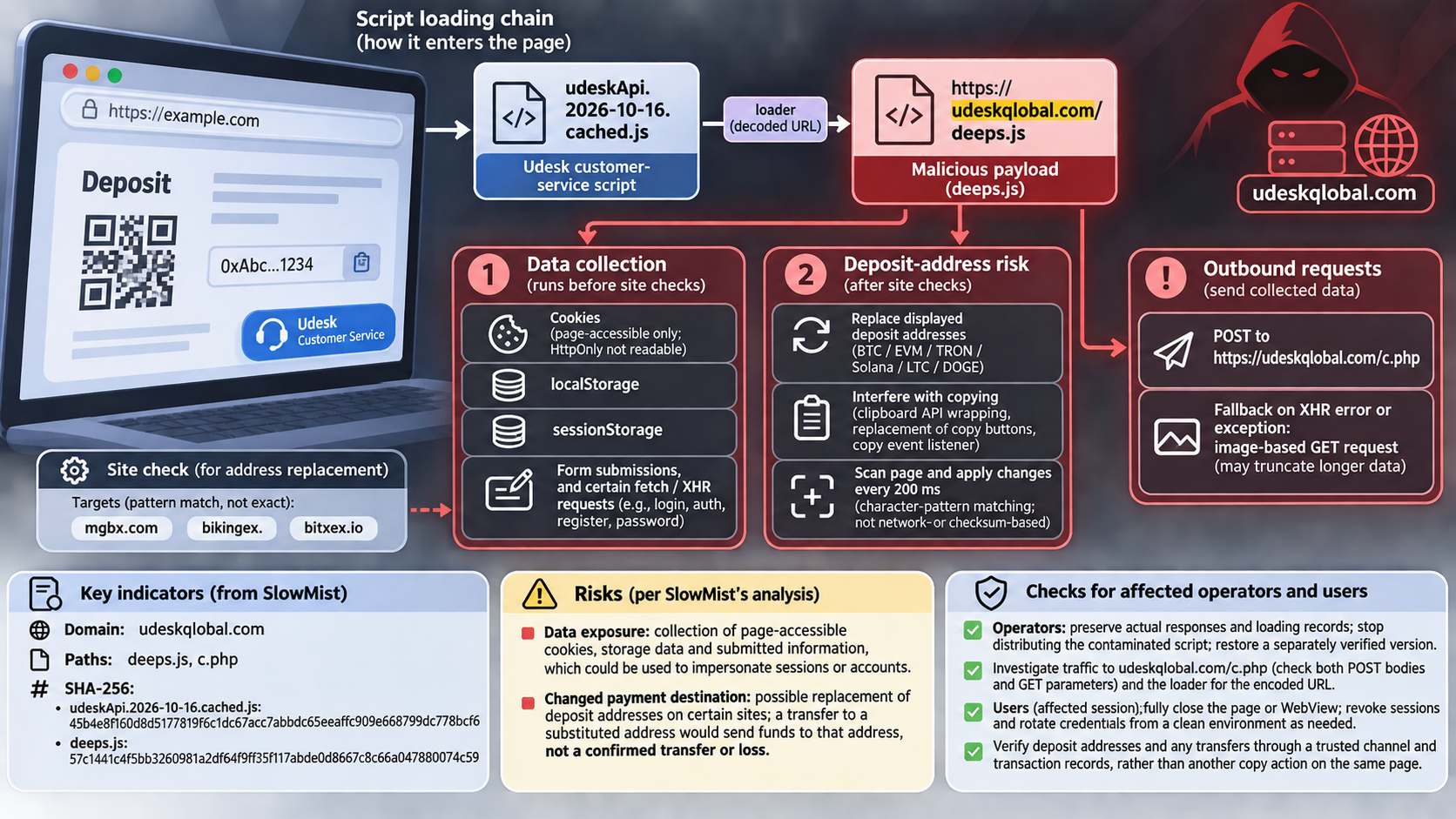
SlowMist examined udeskApi.2026-10-16.cached.js and a second file, deeps.js. At the end of the Udesk script, it found a loader that decoded a URL, created an asynchronous script element and pointed it to https://udeskqlobal.com/deeps.js. The domain uses qlobal, beginning with the letter q. Whether the remote code ran depended on the page loading the script and on browser and network conditions.
The payload read page-accessible cookies, localStorage and sessionStorage, and attempted to send them with the page’s address and origin to https://udeskqlobal.com/c.php. It also hooked form submissions and certain fetch and XHR requests associated with authentication-related URLs. This created a path for submitted information to be copied, although the contents would depend on what a user entered and how a page submitted it. HttpOnly cookies were not readable through document.cookie.
Crucially, SlowMist found that these collection routines ran before the payload checked its three site-specific rules. A page should therefore not be ruled out of the data-exposure investigation merely because it was not one of the sites targeted for address replacement. The sending code attempted an asynchronous POST and, on an XHR error or synchronous exception, an image-based GET request as a fallback; the fallback could truncate longer data.
The separate deposit-address risk
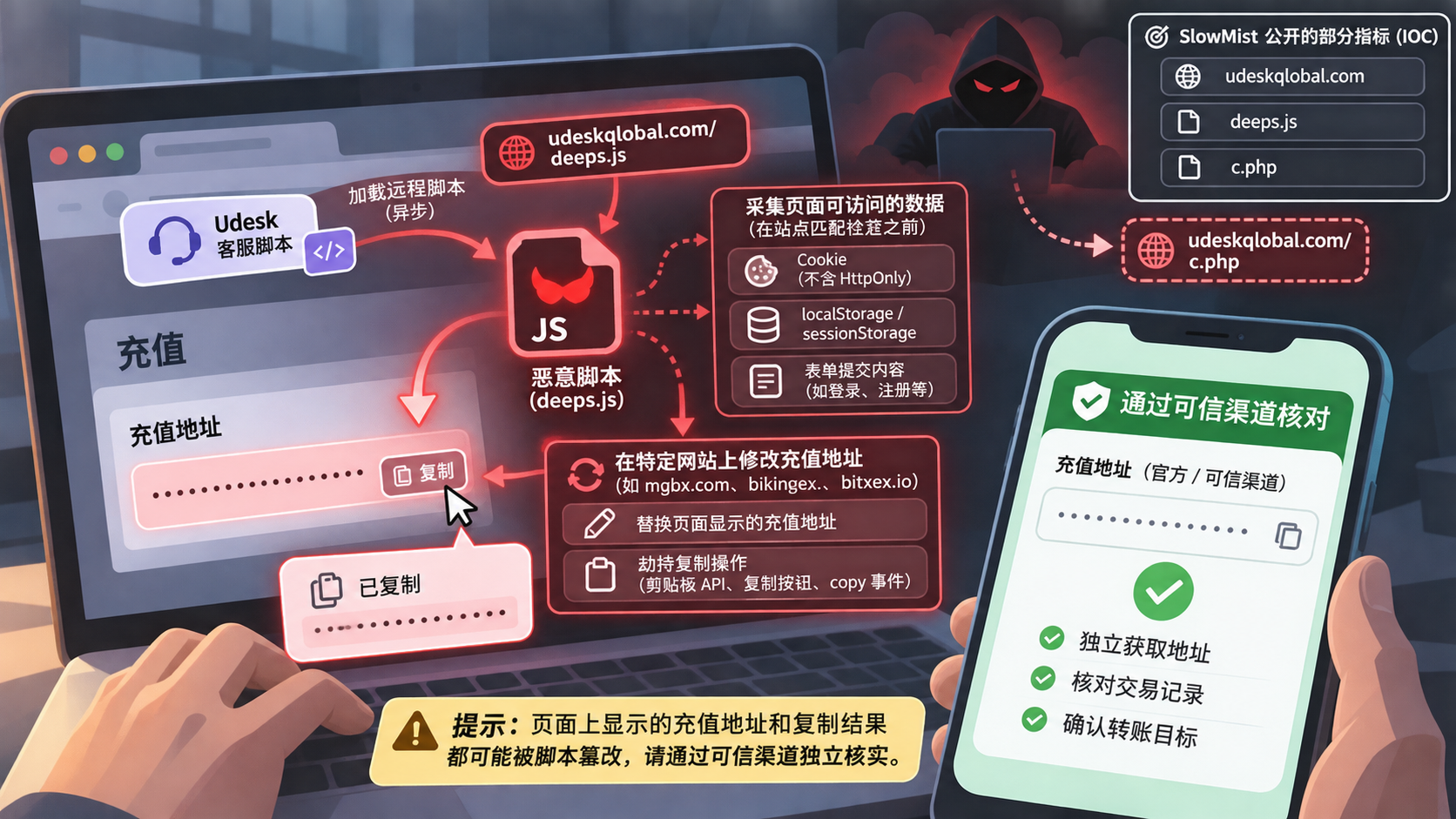
After the site check, the payload targeted pages matching rules for mgbx.com, bikingex. and bitxex.io. SlowMist noted that the matching expressions were not anchored to exact hostnames. On matching pages, the script scanned for addresses every 200 milliseconds and could replace displayed deposit addresses with configured BTC, EVM, TRON, Solana, LTC or DOGE addresses. It also interfered with copying through clipboard API wrapping, replacement of matching copy buttons and a copy event listener. Those paths had different triggering conditions; a matching page was not, by itself, proof that every displayed or copied address changed.
The address detection relied on character patterns rather than checking the network selected by the user or validating an address checksum. SlowMist described a risk that a user completing a transfer to a substituted address would send funds to that address, not a confirmed transfer or loss.
Checks for affected operators and users
SlowMist advised operators still loading the affected resources to preserve the actual responses and loading records, stop distributing the contaminated script, and restore a separately verified version. Investigations should check both POST bodies and GET parameters for traffic to udeskqlobal.com/c.php, as well as the loader for the encoded URL. Removing a script tag alone would not undo hooks and timers already installed in an open document.
For a potentially affected session, the report recommends fully closing the page or WebView and, according to the actual exposure, revoking sessions and rotating credentials from a clean environment. Deposit addresses and any transfers should be checked against a trusted channel and transaction records rather than against another copy action on the same page. These checks address different risks: credential exposure and a changed payment destination.
Indicators published by SlowMist: udeskqlobal.com; deeps.js; c.php. The reported SHA-256 hashes are 45b4e8f160d8d5177819f6c1dc67acc7abbdc65eeaffc909e668799dc778bcf6 for udeskApi.2026-10-16.cached.js and 57c1441c4f5bb3260981a2df64f9ff35f117abde0d8667c8c66a047880074c59 for deeps.js.