An old contract can remain a custody risk while it still holds users’ assets. In an analysis published on June 15, 2026, SlowMist reported that an attacker exploited the deprecated Aztec Connect RollupProcessor on Ethereum on June 14, extracting approximately $2.19 million from its L1 asset pool. Aztec Connect had been deprecated in March 2024, but the immutable contract still held legacy assets.
Where the checks diverged
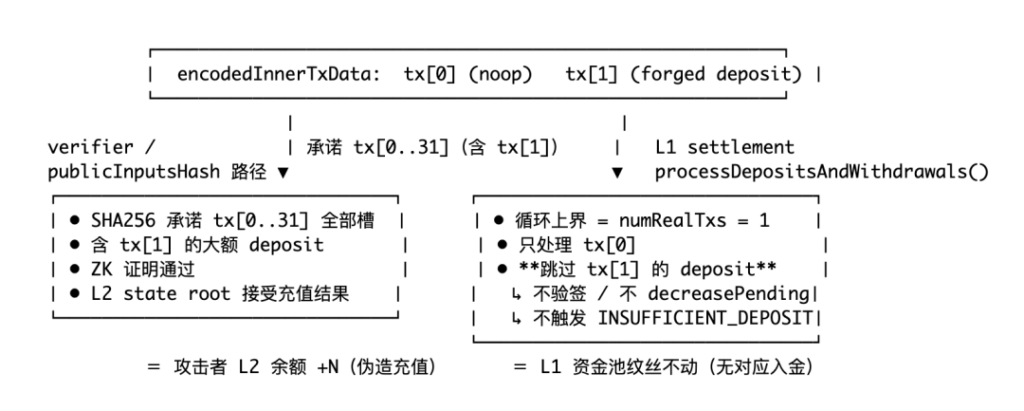
SlowMist identified a mismatch between the public-input slots committed to by a ZK proof and the slots checked by the L1 settlement loop. In the attack calldata, numRealTxs was set to 1. Because the decoded data was rounded up to a 32-slot block, the proof committed to 32 slots, while the L1 loop processed only the first. SlowMist said the remaining 31 slots carried purported deposits that were not subjected to the L1 deposit-balance check; the required circuit constraint on their publicValue was bypassed or not applied.
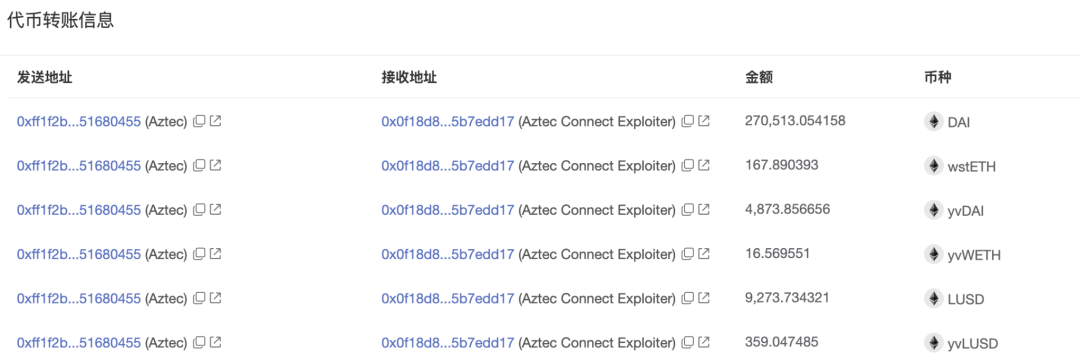
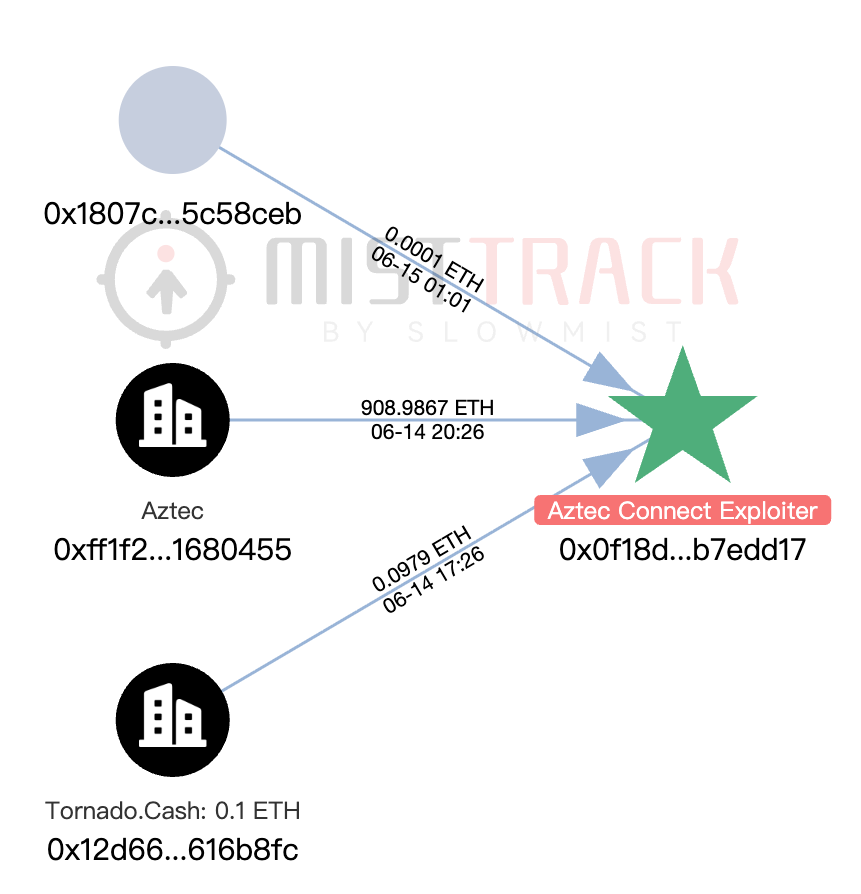
According to SlowMist, the attacker used one atomic transaction containing 14 processRollup() calls: seven to create unsupported L2 balances and seven to withdraw assets from the L1 pool. SlowMist listed the withdrawals as 908.987 ETH, 270,513.054 DAI, 167.890 wstETH, 16.570 yvWETH, 4,873.857 yvDAI, 9,273.734 LUSD and 359.047 yvLUSD. The affected RollupProcessor address was 0xff1f2b4adb9df6fc8eafecdcbf96a2b351680455; the transaction hash was 0x074ec9317d8336db37e8c348fbdd7515573ff4088239c77ab429f522509aeeb1.
SlowMist’s tracing as of June 15, 2026, roughly a day after the exploit, indicated that the assets remained in the attacker-controlled address and had not yet been moved onward. That is a dated observation, not a claim about their current location.
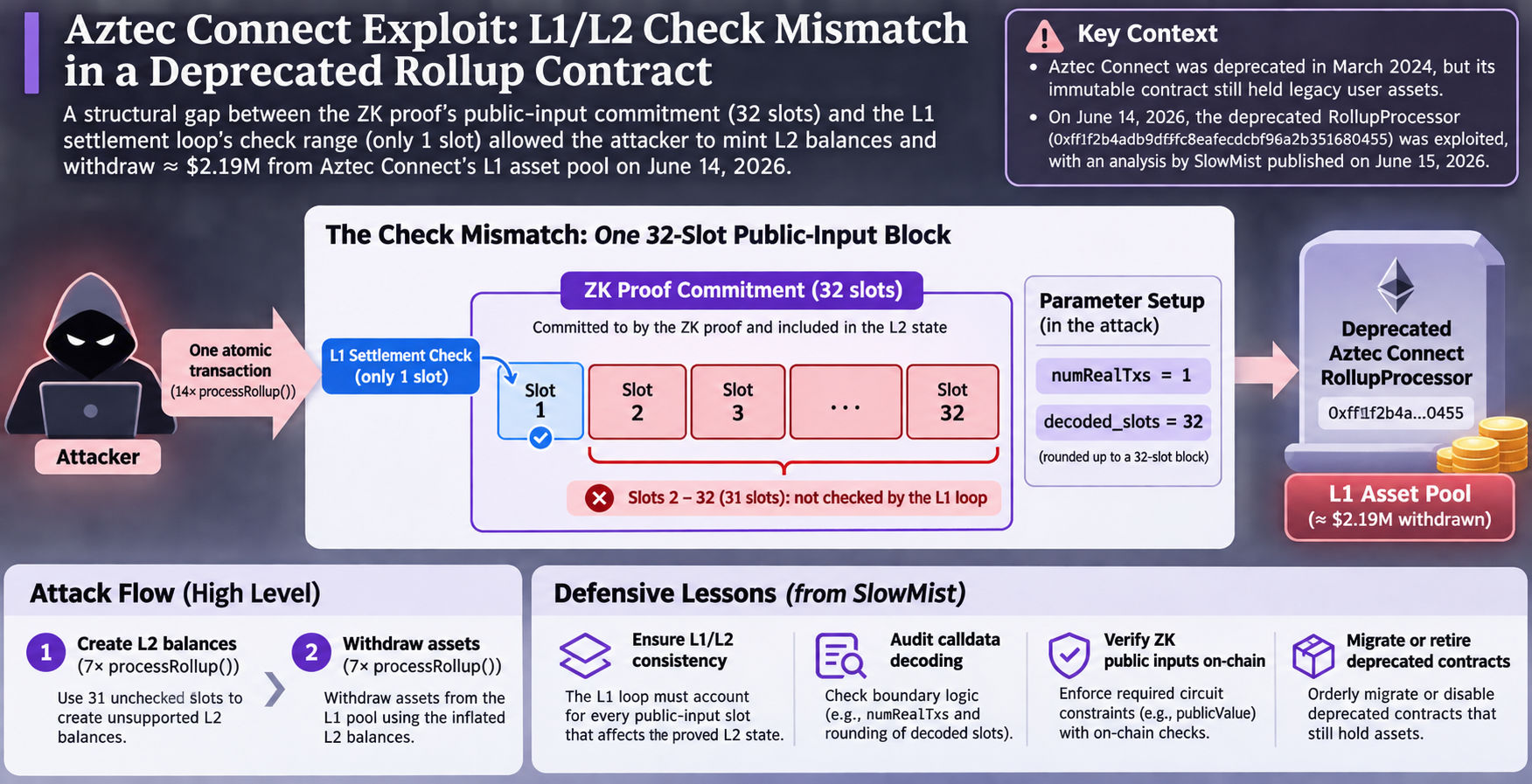
The defensive lesson concerns the boundary between proof verification and custody: a contract that releases L1 assets must account for every public-input slot whose contents can affect the proved L2 state. SlowMist recommended audits focused on L1/L2 consistency, calldata decoding and on-chain checks of ZK public inputs, as well as orderly migration or retirement of deprecated contracts that still hold assets.