If you had liquidity in Chainflip’s vaults, or a swap that depended on them, the practical question after the November 21, 2026 theft was not only whether the software had been patched. It was whether funds could still move, and whether anyone had said how losses would be made good.
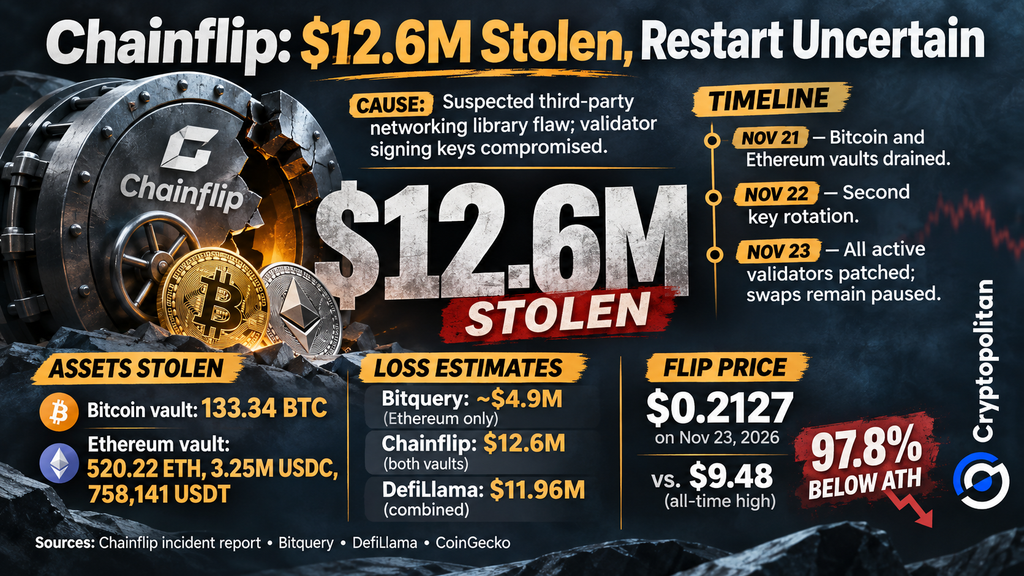
Reporting dated November 24, 2026 said Chainflip had fixed the software running on all active validators and replaced its signing keys after the theft from its Bitcoin and Ethereum vaults. Cryptocurrency swaps remained suspended, with no restart date. The protocol had not yet stated how it would compensate affected liquidity providers or regain traders’ trust.
Shared control is not a closed trust boundary
Chainflip lets users exchange cryptocurrencies across blockchains without using wrapped tokens. Up to 150 validators share control of the signing key used to authorize transactions from the protocol’s vaults. That spreads signing authority instead of leaving it with one operator. The trade-off is that anything able to assemble or misuse portions of that key sits inside the trust boundary, including software validators use to communicate.
According to Chainflip Labs’ November 23 incident report, the attacker did not need to become an active validator. The attacker reportedly exploited a flaw in third-party software that enables communication between validators. The flaw allowed the attacker to obtain portions of the signing key and authorize unauthorized withdrawals.
Chainflip Labs said: “The transactions were authorised with valid vault signatures that the Chainflip protocol never requested: the attacker produced them outside the network.”
Blockchain analytics firm Bitquery reported a matching anomaly on the Ethereum vault. The transaction used to drain the vault had a sequence number that fell outside Chainflip’s usual signing sequence. Bitquery said: “Of the 299,677 signatures the Vault has accepted since 2023, that one alone broke Chainflip’s running count.”
A signature the vault accepted is not, by itself, evidence that the protocol requested the transfer. In this case the break in the running count was the on-chain sign that the authorization was outside normal use.
What left the vaults, and what key changes did not restore
On November 21, the attacker drained 122.86 BTC from Chainflip’s Bitcoin vault. The Ethereum vault was hit next, losing 520.22 ETH, 3.25 million USDC, and 758,141 USDT. Within eight minutes of the second theft, the attacker transferred 2,909 ETH to the cryptocurrency mixer Tornado Cash.
Chainflip’s initial key rotation failed to prevent the theft of another 10.48 BTC. The protocol replaced its signing keys again on November 22. By November 23, all active validators were running the fixed software. Swaps, deposits, and withdrawals were still not available.
A completed key rotation and fixed validator software are not the same as restored access. At the time of the November 24 report, holders still could not treat the vaults as open merely because a patch had been deployed.
A return offer went unanswered; an earlier loss had a voted cover
Chainflip also tried to recover stolen funds. It allowed the attacker to keep 10% of the funds in exchange for returning 110.58 BTC and 2,618 ETH by 18:38 UTC on November 23. As of 20:44 UTC that day, no recovery had taken place. The stolen Bitcoin had not moved from the addresses holding the funds.
The protocol has compensated liquidity providers after a smaller loss. On September 12, Chainflip lost 736,442 USDT because of double withdrawals from its Tron vault. Validators later approved Proposal 008, which used surplus assets to cover those losses. That was an approved use of surplus for that incident, not a standing rule that every later loss would be covered the same way.
The November case involved much more money, and the published figures are not identical. Bitquery estimated the Ethereum vault losses at around $4.86 million. Chainflip said losses from both the Bitcoin and Ethereum vaults reached $12.6 million. DefiLlama put the damage at $11.96 million. Those are an analytics estimate, the protocol’s combined figure, and a separate tally, not one confirmed repayment amount.
Considering the amount lost, Chainflip said it intended to look for financing options and incentives to help liquidity providers recover their capital. That was a stated intention, not an enacted compensation plan and not a completed repayment.

Activity recorded before the halt
DefiLlama figures cited with the November 24 report showed $1.1 billion in swap volume and $629,000 in protocol revenue over 30 days, with $13.6 million in assets locked. The report presented that trading activity as context from before the hack, not as volume continuing while swaps were suspended.
According to CoinGecko, FLIP traded at $0.2127 on November 23, nearly 97.8% below its all-time high of $9.48. That is a price reading on that date. It does not, by itself, show how much of the decline from the all-time high was caused by this theft.
Chainflip’s reported view was that it could restore previous trading volumes with only a fraction of the stolen capital. The challenge it identified was convincing liquidity providers to commit funds again. The report did not set a restart date or a recovery target.
A longer halt elsewhere is context, not a forecast
The same report used THORChain to illustrate how hard it can be to attract liquidity after a vault incident, not to predict Chainflip’s outcome. THORChain resumed trading after a 39-day shutdown following a $10.7 million vault exploit in May. Despite security upgrades and compensation measures, its token price and liquidity remained below pre-hack levels when trading resumed.
Wider tallies in the report point past smart-contract code alone. CertiK recorded $232.9 million in cryptocurrency security losses between November 1 and November 23, 2026. CoinGecko’s 2026 security report found that infrastructure and supply-chain vulnerabilities accounted for more than $1.8 billion in losses between January 2025 and July 2026. In Chainflip’s case, the incident report placed the flaw in third-party software used for validator communication.
One check while service is still closed
For someone waiting on funds, separate three states: validator software has been fixed, signing keys have been replaced, and deposits or withdrawals are actually open. By November 23 the first two were reported done. The third was not.
A further check supported by this incident is whether notes on a shared-vault protocol cover third-party software that carries key material between validators, and whether accepted vault signatures still follow the protocol’s own sequence. Neither check returns stolen funds, and neither means a custody design has removed the risk of an unauthorized but valid-looking signature. Until an enacted compensation method is stated, recovery for liquidity providers remains unresolved rather than guaranteed.