Who decides when a bridge can release funds? The researchers behind Praxis propose making release depend on a valid cryptographic proof rather than on operators and challengers watching for misbehavior. Their demonstration shows that the underlying encryption can run on a standard laptop. It does not demonstrate a working bridge, and the proof system they used still requires an honest setup.
On November 23, 2026, Stanford’s David Tse and Byzantine Research’s Nikhil Vanjani and Psi Vesely presented Praxis: Practical Witness Encryption for NP. The authors describe it as the first practical witness encryption scheme for general NP statements.
What the laptop test showed
Witness encryption, introduced in 2013, lets someone encrypt a message without choosing a recipient or sharing a decryption key. Instead, the sender specifies a condition. Anyone who knows a valid solution, called a witness, can decrypt the message. NP is the class of problems for which a proposed solution is efficient to check, even if finding one is difficult. Supporting general NP statements means the scheme is not limited to a single purpose-built condition.
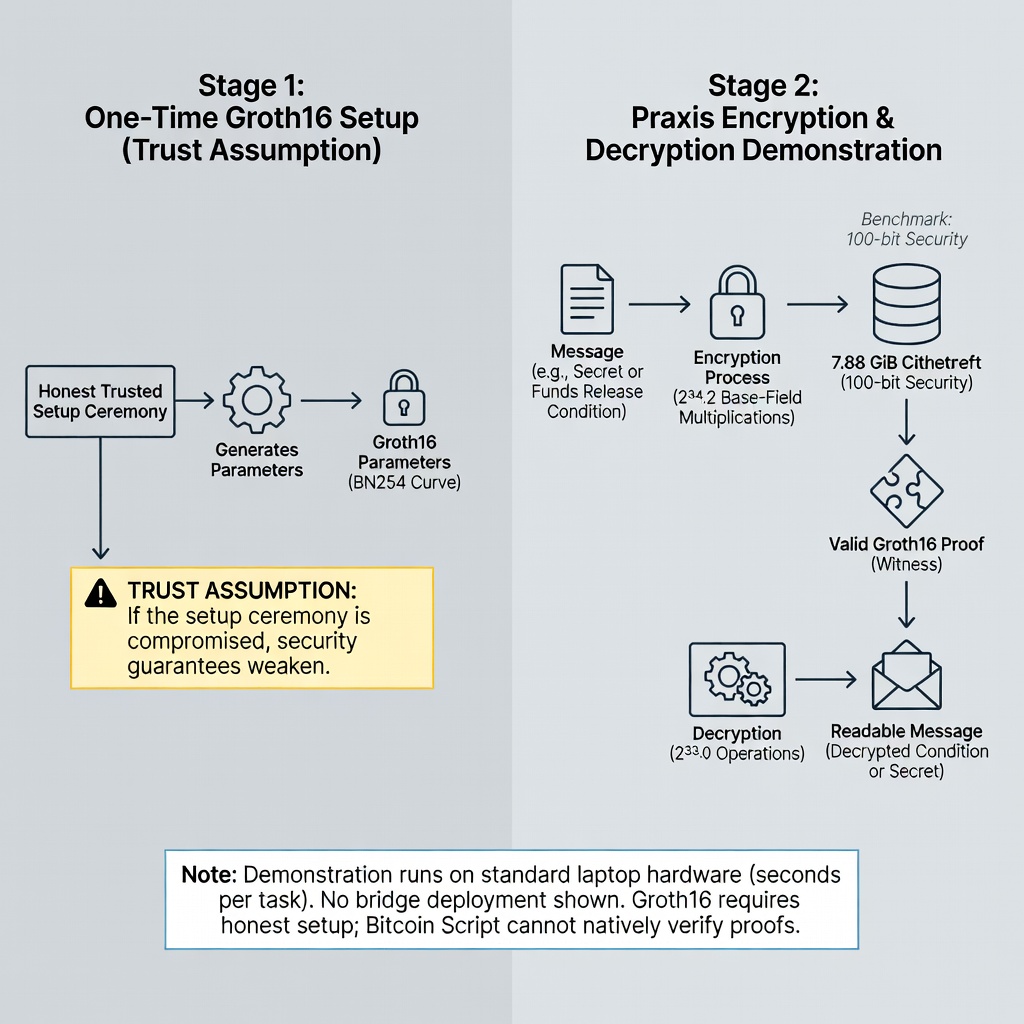
The team tested Praxis with a verifier for Groth16, a zero-knowledge proof system, on the BN254 elliptic curve. In this example, a valid Groth16 proof serves as the witness. At 100-bit security, the authors report a 7.88 GiB ciphertext, more than ten orders of magnitude smaller than the earlier Hair–Sahai constructions from 2026.
Encryption required approximately 2^34.2 base-field multiplications. With a valid proof, decryption averaged roughly 2^33.0 operations. The team reports that each task finished within seconds on standard laptop hardware. For a Bitcoin application, the remaining constraint is storage: the ciphertext is too large to put directly onchain. A bridge designer would still need to specify where it is stored and how users can obtain it.
What a Bitcoin bridge would still need to trust
Bitcoin Script cannot natively verify complex proofs such as Groth16 proofs. The researchers suggest that locking funds or secrets to a proof could allow non-interactive verification without the operators and challengers that current approaches rely on. They also point to atomic swaps, in which an exchange across two chains either completes on both sides or not at all. The announcement identified no live integration with a bridge or other protocol.
Praxis’s security argument concerns extractability: roughly, anyone who succeeds in decrypting must know a valid witness. The authors prove this in the bilinear generic group and random oracle models, both idealized frameworks, under the Module-SIS lattice hardness assumption. They also supplied machine-checkable Lean 4 proofs of correctness and extraction for their chosen parameters.
Those proofs do not establish that a particular Groth16 setup ceremony was honest. If the one-time generation of its parameters is compromised, the guarantees weaken. The distinction matters for a prospective bridge user: removing the need for someone to monitor releases would not remove the need to trust how the system was initialized.