If you expect to hold ether or sign from the same wallet for years, the signature scheme behind those keys is part of the trust boundary you are relying on. That boundary is what the Ethereum Foundation now says it intends to change.
Foresight News reports that the foundation’s official blog has announced a plan to replace elliptic-curve cryptography with hash-based cryptography, and to treat a “post-AI, post-quantum” upgrade as Ethereum’s highest priority. The blog describes this upgrade as harder, and on a tighter schedule, than the Merge completed on September 15, 2022, while saying the foundation now has stronger tools than it had then.
The stated case for hashes is limited. After more than a year of evaluating candidate signature schemes, the foundation argues for hash-based cryptography because the Ethereum protocol already depends on the security of hashes. On that account, the change would not introduce a new security assumption. That is a claim about what the protocol already assumes, not a claim that any custody setup removes risk.
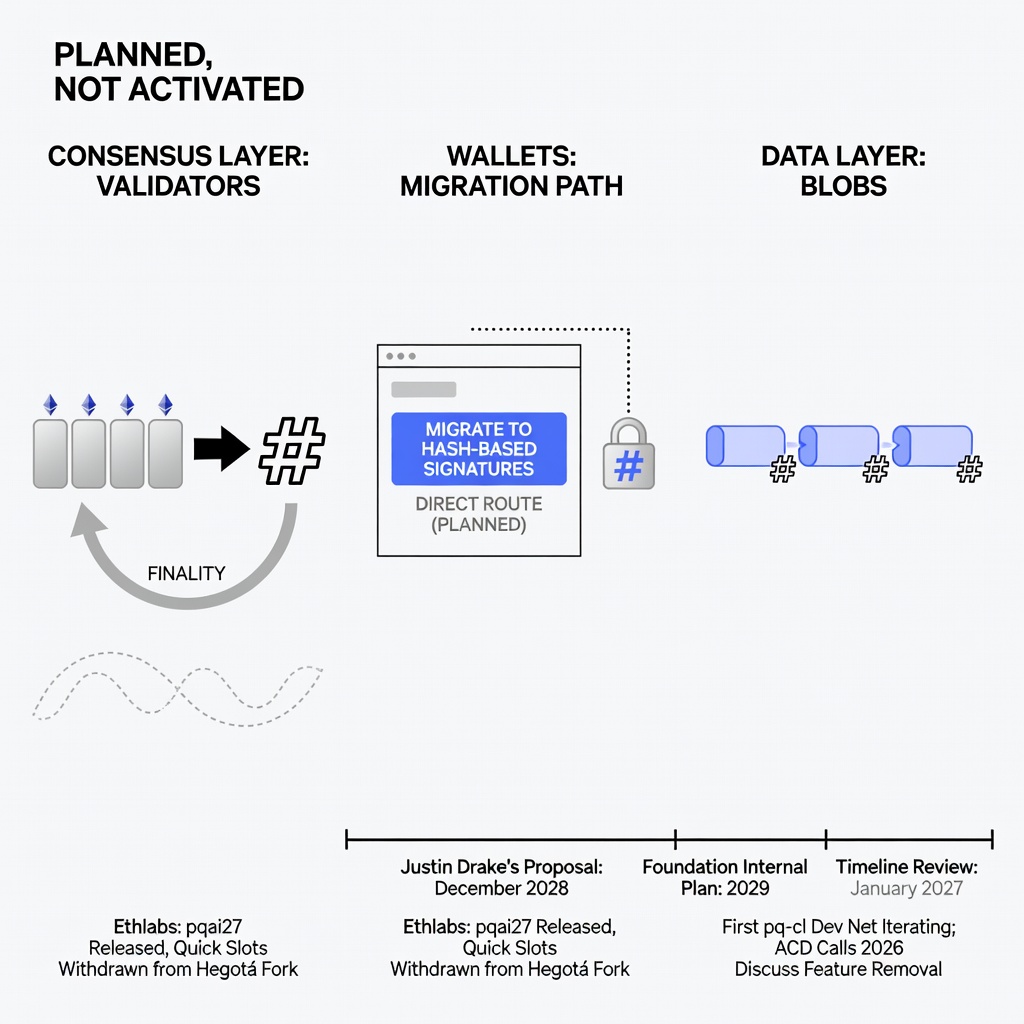
The same account splits the upgrade into three parts, none of them described as already activated:
- Consensus-layer validators would move to hash-based key signatures, so finality would no longer depend on elliptic curves.
- Wallets would offer users a direct path to migrate to hash-based signatures.
- Data-layer blobs would switch to hash-based commitments.
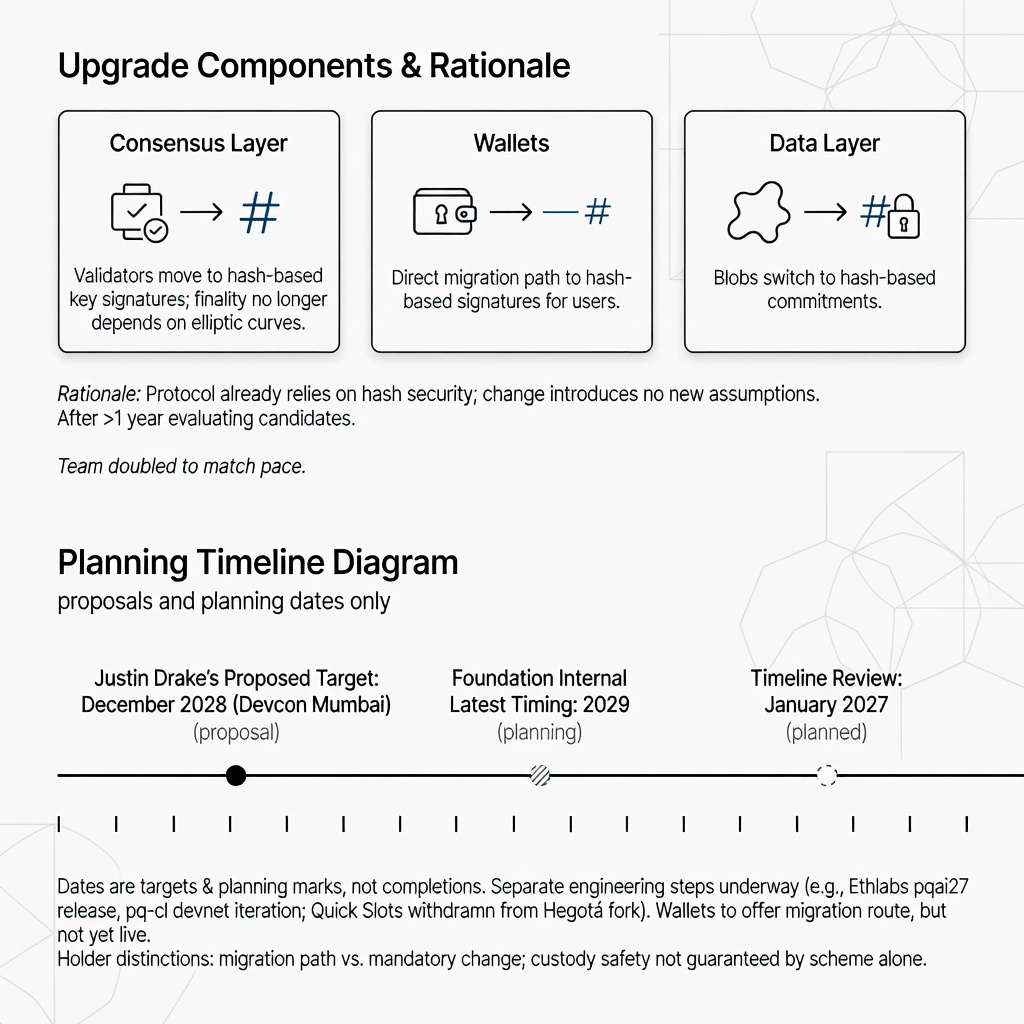
To match the development pace, the foundation says it has doubled the size of its protocol security team.
The dates attached to the work are targets and planning marks, not completion dates. Justin Drake proposed December 2028 as the goal at Devcon in Mumbai. The foundation’s internal plan puts the latest timing in 2029, and it plans to review the timeline in January 2027.
Separate engineering steps are also reported as underway, not as a finished protocol change. Ethlabs has released pqai27 and withdrawn its Quick Slots proposal from the Hegotá fork in order to free engineering resources. The first pq-cl development network has started iterating. Remaining ACD calls in 2026 are expected to discuss whether more features should be removed from the fork.
For a holder, the useful distinction is between a migration path that may be offered and a change you must already make. The blog says wallets will be given a direct route to hash-based signatures. It does not say that route is live. Accessibility of a future migration, confidentiality of the keys you already control, and redundancy in how you back them up remain separate questions. A planned change in signature scheme does not, by itself, make a custody setup safe.