Can a wallet holder verify that the chip inside a device matches its published design? On November 28, 2026, at 08:16:47 UTC+8, ChainCatcher reported, citing Bitcoin.com, that Ethereum co-founder Vitalik Buterin had proposed making hardware wallet chip designs public down to the factory blueprints. Independent examiners could then compare a physical chip with the plans.
Buterin said examiners could use infrared imaging to inspect a chip, though detecting subtler tampering might require taking it apart layer by layer. He acknowledged that even this approach would not eliminate the need for trust.
Ledger chief technology officer Charles Guillemet disagreed with the proposal. Publishing a design, he argued, does not prove that the hardware a particular user receives conforms to it. He also distinguished openness from security: making code open source is not itself a security property, and review by many people does not guarantee that the code is secure.
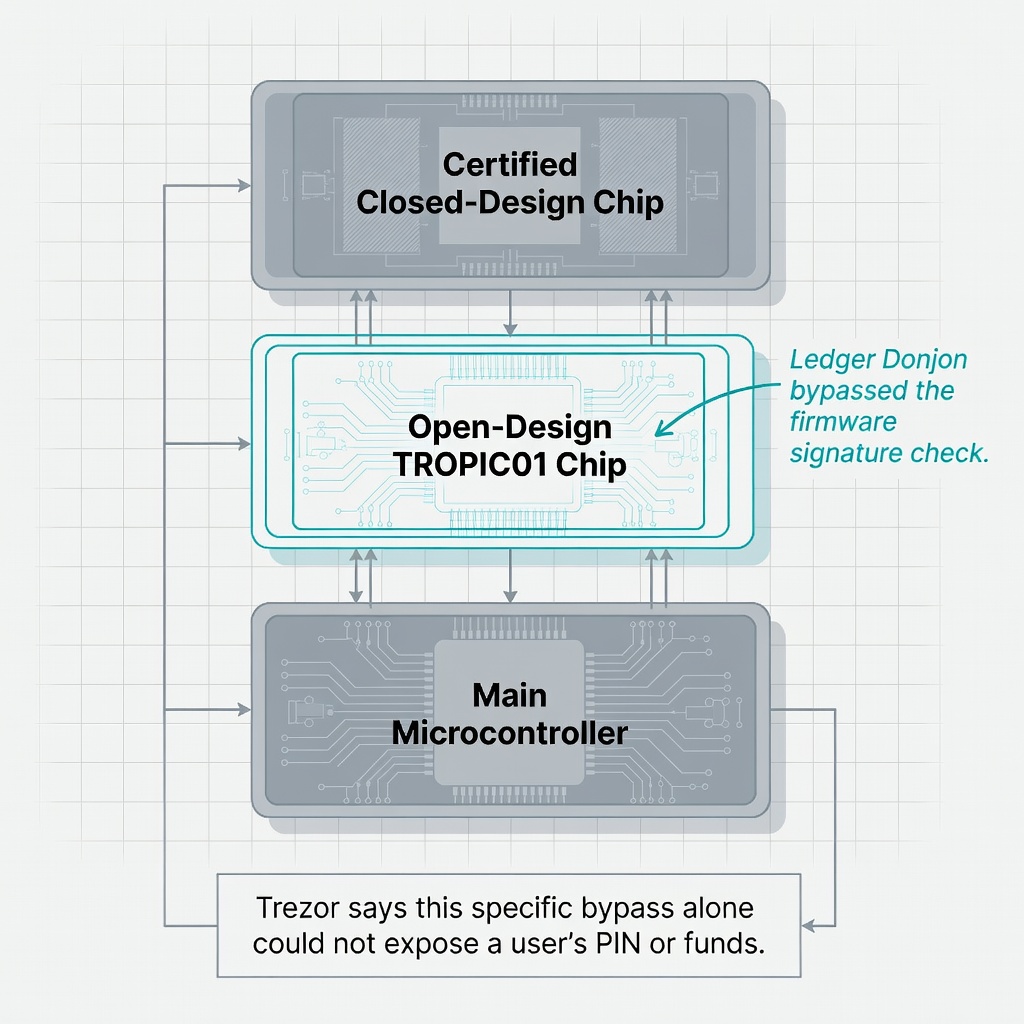
The Trezor Safe 7 illustrates a separate question: what does a flaw in one component mean for the wallet holder? Its layered design combines a certified closed-design chip, an open-design chip and a main microcontroller. Ledger’s Donjon team used a laser to bypass the TROPIC01 chip’s firmware signature check. Trezor said that, because of the wallet’s layered design, this particular bypass alone could not expose a user’s PIN or funds.