If you use a social login to recover a wallet, the practical question is who—or what—must be available and trustworthy when you need your keys back.
In an article published November 10, 2026, at 14:04 (UTC+8), Liu Jiaolian reported that assets had been transferred out of several thousand Keplr social-login wallet accounts. The article said Keplr attributed the problem to a vulnerability in Web3Auth’s infrastructure, but also noted that the technical cause had not been disclosed in detail. The account count and cause are therefore reported claims, not independently established findings in the source.
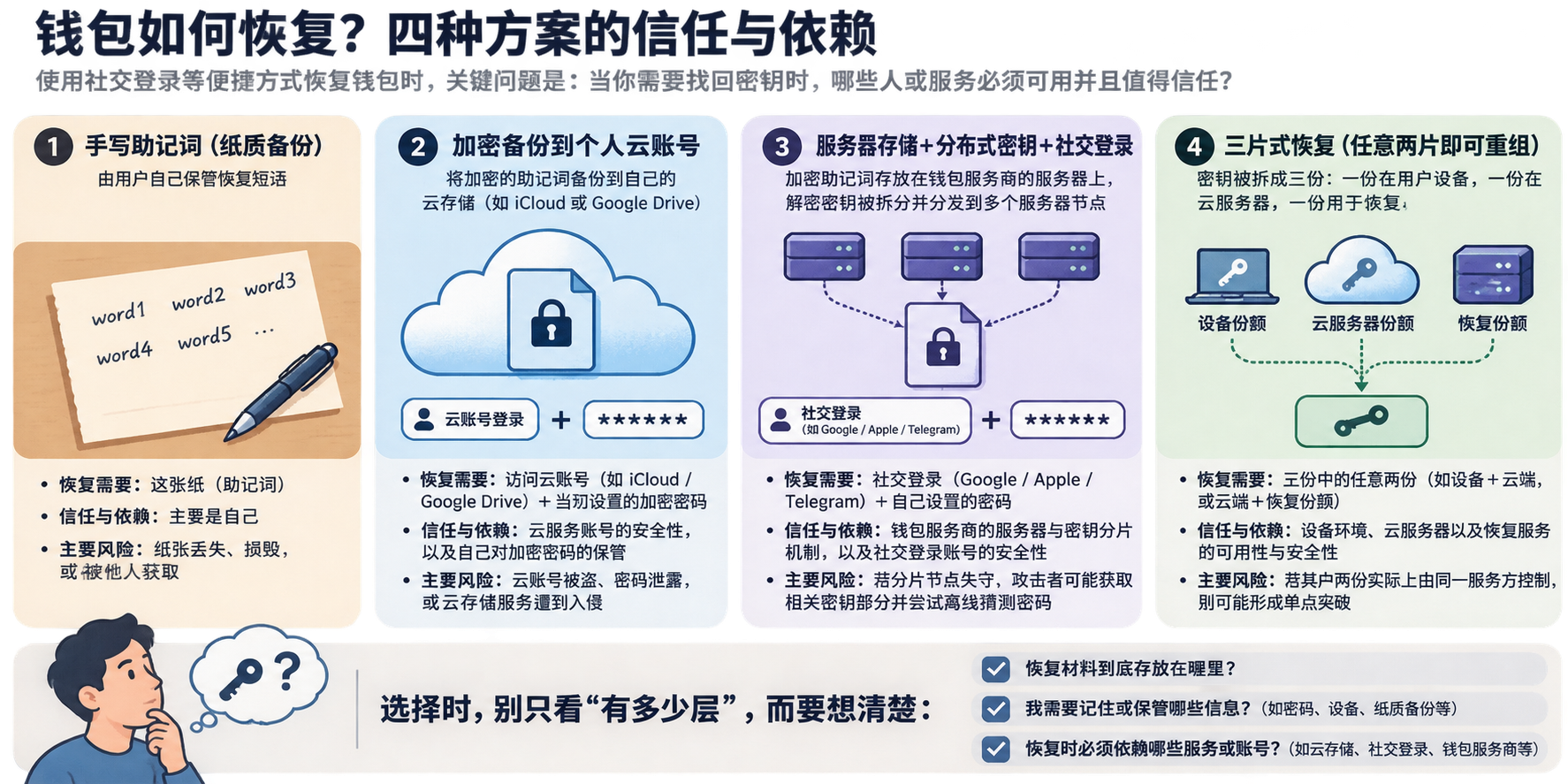
Four approaches to recovery
The article compares a handwritten recovery phrase with three wallet approaches. A phrase kept on paper leaves the holder responsible for both keeping it confidential and ensuring it remains available. Losing the paper can mean losing access; someone else finding it can compromise control.
According to the article, Uniswap Wallet offers an encrypted recovery-phrase backup in the user’s iCloud or Google Drive account. Recovery requires access to that cloud account and the separate password used to encrypt the phrase. That can make a backup easier to retrieve, while adding dependencies on account access and password protection.
The article describes MetaMask’s social-login recovery as storing an encrypted phrase on MetaMask’s servers and distributing parts of the decryption key across server nodes. It says recovery requires both a Google, Apple or Telegram login and a user-set password. The author argues that, if an attacker obtained the relevant key parts, they could attempt to guess the password offline without the rate limits of online recovery. This is the author’s analysis of a possible failure condition, not a reported MetaMask breach.
For the Keplr arrangement discussed, the article describes three key shares: one on the user’s device, one on a cloud server and one for recovery. Any two can reconstruct the key. The author speculates that the incident might involve a situation in which two shares effectively came under one provider’s control, but says further technical disclosure is needed to establish what happened.
The useful check is not simply how many layers a wallet advertises. It is whether you can identify where your recovery material resides, what you must remember or retain, and which services must work when you restore access. Convenience may reduce the chance of losing a handwritten phrase, but it introduces dependencies that deserve the same attention as the backup itself.
Source: techflowpost.com (originally published 2026-11-10 14:04 UTC+8)