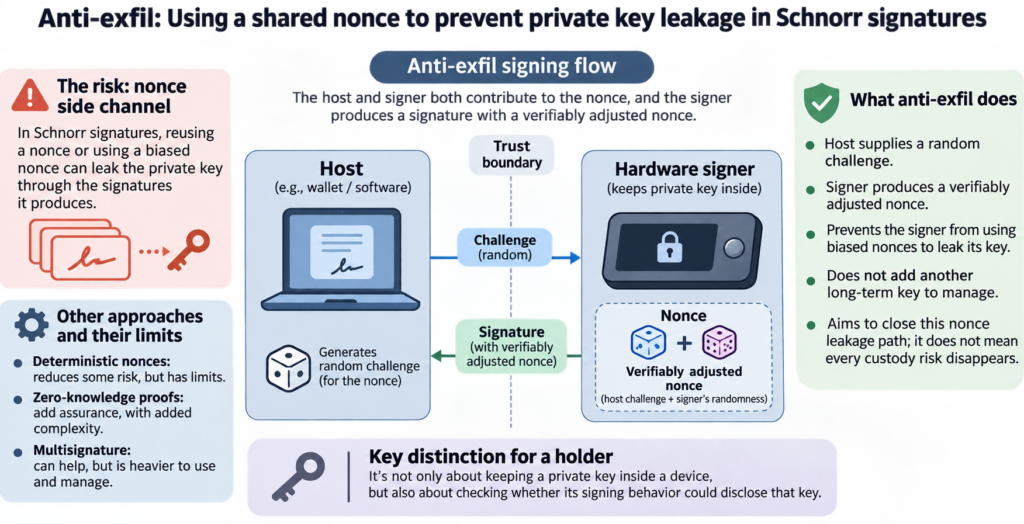
A hardware signer can keep a private key inside the device while still putting it at risk through the signatures it produces. In a transcript published on November 15, 2026, Andrew Poelstra explains how nonce reuse or bias in Schnorr signatures can leak a private key through a side channel.
Poelstra discusses the limits of deterministic nonces, zero-knowledge proofs and multisignature approaches before describing anti-exfil. In the approach he presents, the host supplies a random challenge and the signer produces a verifiably adjusted nonce. The host and signer thus both contribute to the nonce without adding another long-term key to manage. The aim is to prevent a signer from using biased nonces to leak its key; it is not a claim that every custody risk disappears.
The transcript also covers Blockstream Jade’s implementation, PSBT interaction and an earlier application involving OpenTimestamps. For a holder, the key distinction is between keeping a private key inside a device and checking whether its signing behavior could disclose that key.