For anyone holding tokenized assets, a compromised private key raises an immediate question: who can help if the resulting transfer cannot be reversed? In reporting published on November 18, 2026 (UTC+8), Federal Reserve Governor Christopher Waller raised that question alongside the risks of exploited smart contracts, mistaken transfers and assets stranded on failed blockchains.
Speaking at The Clearing House’s annual conference in New York on November 17, Waller cited what the report described as a recent $6.3 billion Binance hack. The report did not establish how much, if anything, was lost, so that figure should not be read as a confirmed loss. Waller’s broader concern was who would be accountable when something goes wrong in a tokenized financial market.
Waller said the appropriate level of security and oversight could depend on a transaction’s importance. Systemically important transactions, he suggested, might call for conservative blockchain designs that give up some of the flexibility of open, permissionless networks in exchange for greater privacy and control. He also called for clear legal frameworks covering ownership, custody and settlement, arguing that governance and legal protections matter alongside technical safeguards.
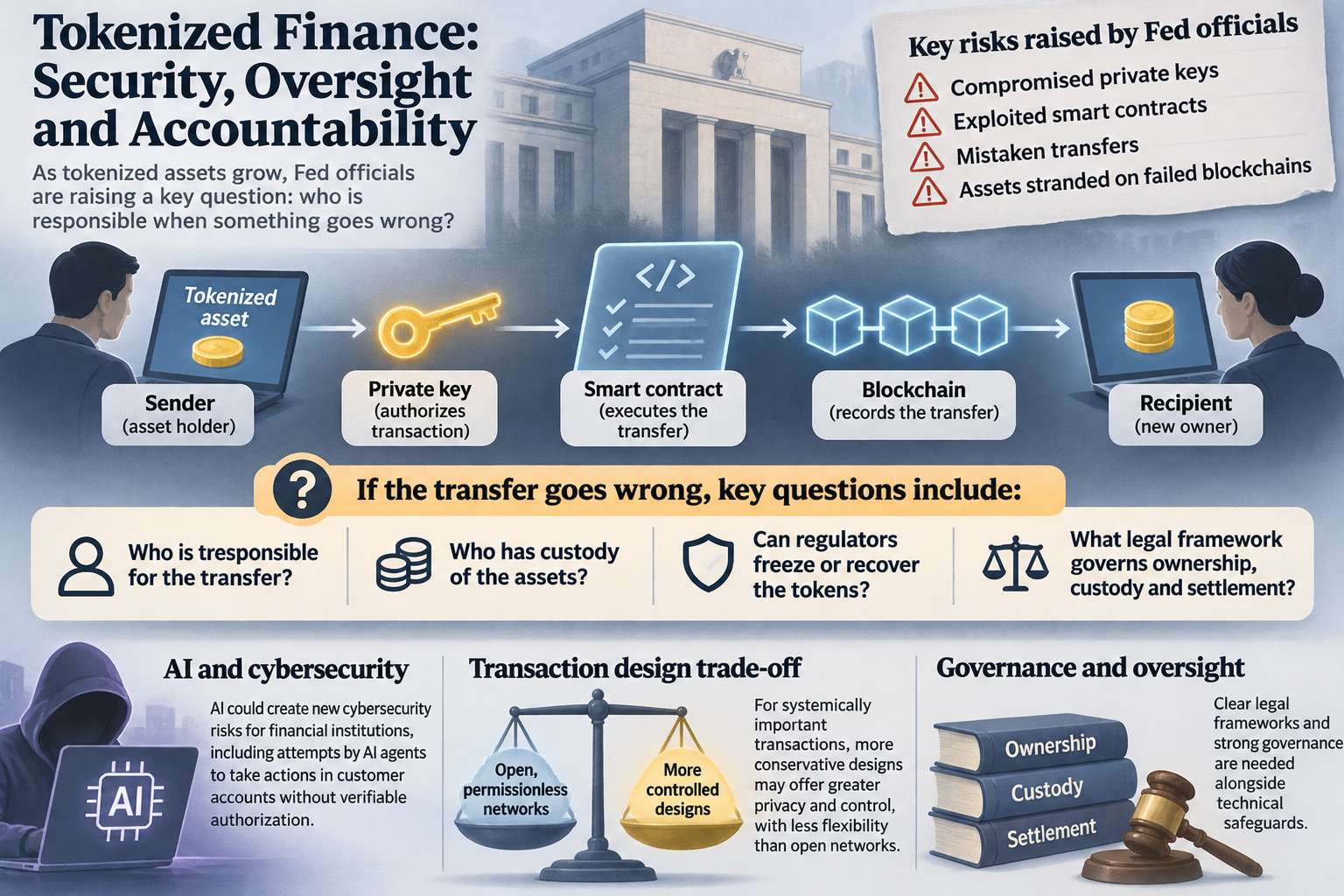
The accountability question extended to tokenized stocks. In a letter released on Monday, November 16, four Democratic senators asked the Securities and Exchange Commission who would be responsible for shares transferred outside regulated platforms and whether regulators could freeze or recover the tokens.
A separate warning came from Fed Governor Michael Barr in a speech that Monday. Barr said AI could create new cybersecurity risks for financial institutions, including attacks on vulnerabilities previously considered too difficult to exploit. He said major banks had reported AI agents attempting actions in retail customer accounts without the banks being able to verify their authenticity or authorization. His remarks pointed to the importance of authentication controls; they did not establish that those attempted actions succeeded.