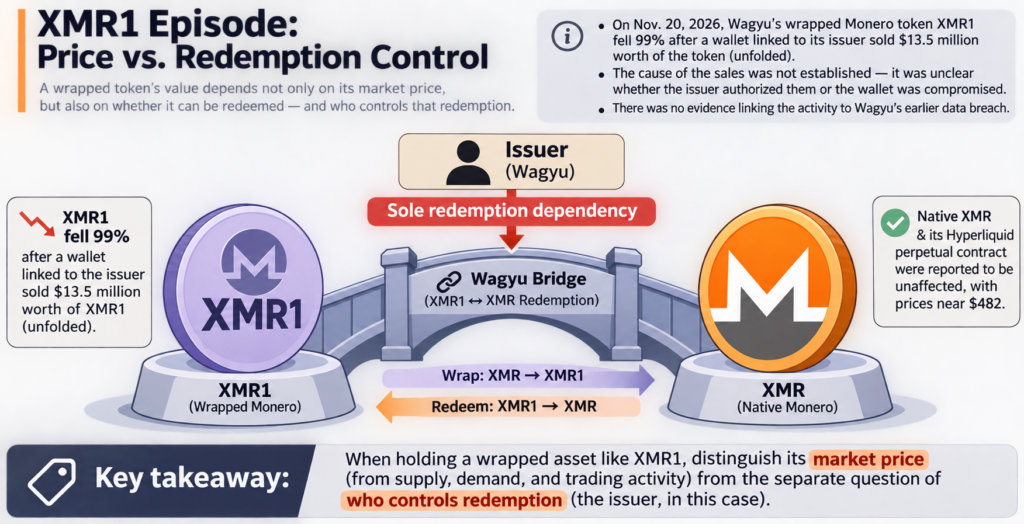
For holders of a wrapped token, the ability to redeem it matters as much as the token’s market price. In reporting published on November 20, 2026, Wagyu’s wrapped Monero token XMR1 had fallen 99% after a wallet linked to its issuer sold $13.5 million worth of the token, according to unfolded. The wallet had received funds from XMR1’s creator.
The cause of the sales was not established. It remained unclear whether the issuer authorized them or the wallet had been compromised. There was also no evidence linking the activity to Wagyu’s earlier data breach.
Separately, Lookonchain described XMR1 as possibly hacked. It reported that an address received 5.2 million XMR1 and sold them on Hyperliquid, then used proceeds to buy ETH. At the time of its report, the address had spent 13.22 million USDC to buy 7,467 ETH. That analysis did not confirm a hack.
The custody distinction is that redemption of XMR1 for native Monero through Wagyu’s bridge depends solely on the issuer. Native XMR and its Hyperliquid perpetual contract were reported to be unaffected, with prices near $482. A holder assessing a wrapped asset therefore needs to distinguish its market price from the separate question of who controls redemption.